The global data center spending is estimated to reach $7 trillion by 2030. The number is big enough to make one thing clear: data centers are no longer just real estate or IT infrastructure. They are becoming the physical backbone of the global economy.
Most of the attention is on the buildout. Faster capacity, larger campuses, power access and AI readiness dominate the headlines. But the faster this infrastructure scales, the faster another cycle begins beneath it: hardware refresh.
In AI infrastructure, equipment can age before it is physically old. A server built for yesterday’s workload may struggle with tomorrow’s model, tomorrow’s chip architecture or tomorrow’s power requirements. At data center scale, upgrades do not happen as isolated swaps. They happen in waves.
What looks like innovation on the front end becomes a high-stakes removal problem on the back end. That is when the data risk moves from the rack to the road.
A decommissioned server may still carry customer records, financial data, health information, proprietary models or business activity. If it is lost, mishandled or resold without proper controls, the damage can move from asset recovery to legal exposure and public trust.
Please watch our demo video here.
That is why IT asset disposition has become a strategic market. Data center ITAD is projected to grow to $33.6 billion by 2035. The industry already handles certified destruction, recycling, remarketing and audit documentation. The next layer is not more paperwork. It is live custody intelligence: knowing where the asset is, what condition it is in and whether the right asset reached the right step while the process is still happening.
Nuclear fuel is handled with discipline even after its primary use is over. The concern is not just disposal. It is preventing leaks, contamination and future harm. Data-bearing hardware carries a different risk, but the principle is similar: end of use is not end of responsibility.
A disposal lapse can become a headline: Morgan Stanley Smith Barney paid $35 million after decommissioned devices with customer PII entered a weak disposal process, including 42 missing servers.
This is a problem space where Sensitel has previously innovated in securing high value shipments.
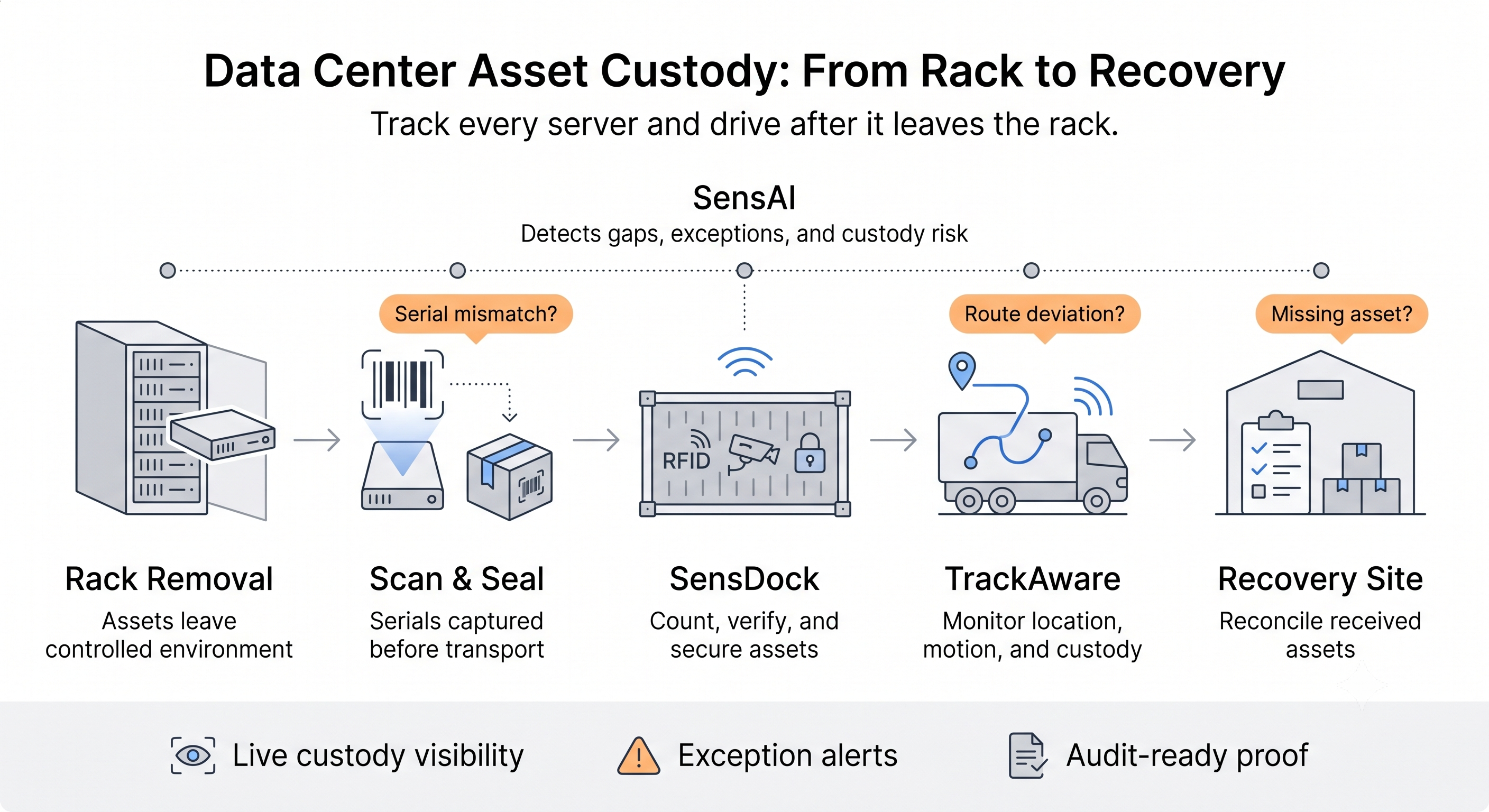
Sensitel’s TrackAware is built for tracking high-value, mission-critical deliveries. In a data center decommissioning workflow, that means secure transport visibility: live location, route monitoring, geofence alerts, predictive arrival times and proof of delivery.
Sensitel’s SensDock extends that visibility to containers and docks. It helps teams confirm what was packed, what moved, what arrived and what needs reconciliation before small mismatches become audit problems.
Sens AI adds visual intelligence at critical custody moments. Cameras can help verify receiving, sorting and destruction, creating evidence that the right asset reached the right step.
Together, these systems create a live custody layer around retired data center assets. For ITAD providers, that can become a premium customer-facing capability. For data center operators, it can become a stronger assurance that sensitive infrastructure does not disappear into a black box once it leaves the rack.
The Gita reminds us that whatever comes into being must one day pass away. Infrastructure is no exception.
In the AI era, trust will not belong only to those who build the fastest but to ones who build responsibly.